Taking a loan is one of the largest financial commitments made by individuals – whether they are taking a home loan, car loan, loan for their education, or for some personal need. However, there is always that crucial question at hand for every borrower before they commit to a loan – "how much will I have to pay every month?"
An EMI calculator helps in determining precisely that. In this article, we will explore what an EMI calculator is, how it works, and how the mathematical formula behind it works.
What Is an EMI Calculator?
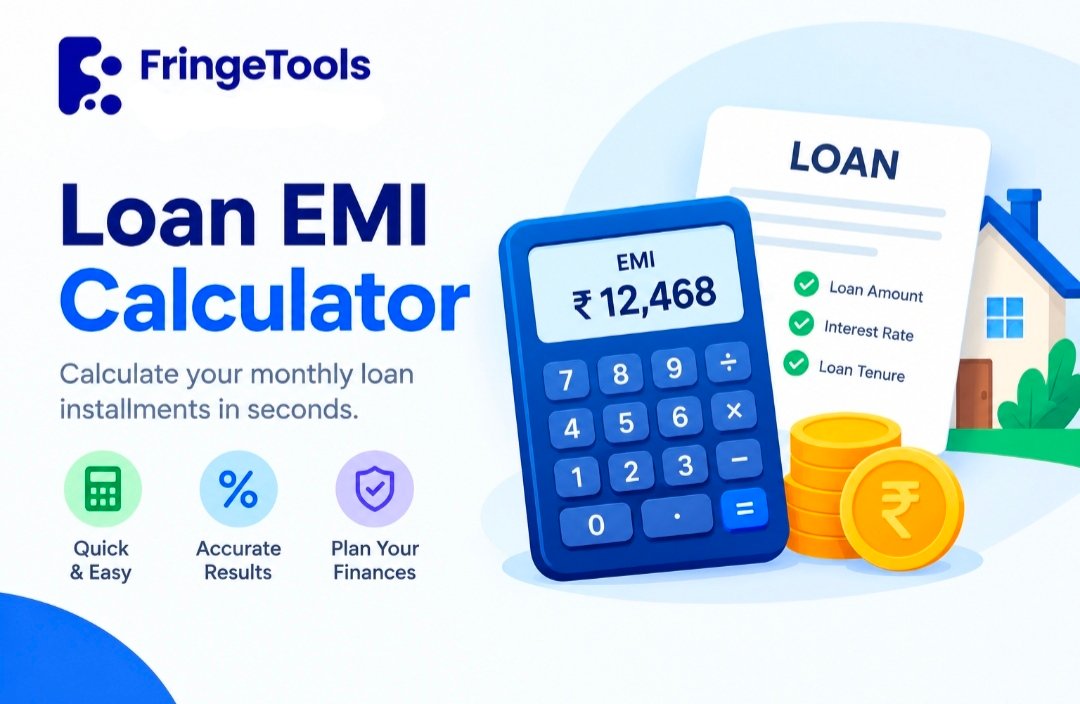
An EMI Calculator is an online tool that is used to calculate the fixed monthly amount that need to be paid back for a loan. The EMI Calculator which is also known as the equated monthly interest calculator, requires just three basic input parameters- loan amount, loan tenure, interest rate , to show you monthly EMI, total interest amount, and total repayment amount instantly.
With the help of an EMI Calculator you can save time from doing manual calculations, and getting information from a bank representative regarding the calculation of EMI and other amounts, thus making EMI calculator making thus most popular among other calculators.
Why Use an EMI Calculator Before Taking a Loan?
Often enough, people tend to apply for a loan without realizing whether they would actually afford paying back the amount borrowed. There are several reasons why you should use the EMI calculator before making any decision about getting a loan:
• Budget planning: By using an EMI calculator, you get the exact number that will indicate the percentage of your salary that is to be used on repaying the loan.
• Comparing the terms of loans offered: Various banks give different rates of interest on loans as well as various loan tenures. EMI calculators help you compare the conditions and choose the most profitable one.
• Understanding the true cost of borrowing money: Low EMI does not always indicate the lowest cost of your loan. The calculators help you understand the actual total amount of interest that you have to pay for the loan.
• Planning your loan tenure: With the calculator you are able to try different scenarios in order to choose the most appropriate loan term and tenure.
• Preventing yourself from overborrowing.
The EMI Formula Explained
Behind every EMI calculator is a simple mathematical formula:
EMI = [P * R * (1+R)^N]/[(1+R)^N – 1]
Where,
•P = Principal Loan Amount
•R = Monthly Interest Rate (Interest rate/12 * 100)
•N = Loan Tenure (in Months)
Calculation of EMI
For instance, let us suppose that you are taking a home loan for ₹30,00,000 with an interest rate of 8.5% annually for 20 years (240 months).
•P = 30,00,000
•R = 8.5/12/100 = 0.007083
•N = 240
On plugging in these values, we will get an EMI of about ₹26,035 per month. In all, after 20 years, the total payment would be around ₹62.5 lakh, out of which ₹32.5 lakh would be paid just for the interest on the loan.
This is precisely the kind of information provided by a EMI Calculator.
How to Use an EMI Calculator
Using an EMI calculator is very easy. All you need to do is use a calculator that follows a similar pattern:
1.Provide the loan amount you are willing to borrow.
2.Provide the interest rate provided by your bank (interest rates differ depending upon your credit score and the nature of the loan).
3.Provide the tenure of the loan, either in years or in months.
4.Click the calculate button and find out your EMI, the total interest you will have to pay, and the total loan amount.
Some advanced calculators also allow you to include the processing fee and the prepayment amount.
Factors That Affect Your EMI
Understanding what influences your EMI can help you make smarter borrowing choices.
1. Loan Amount
The higher the principal, the higher your EMI, assuming the interest rate and tenure remain constant. Borrowing only what you need — rather than the maximum you're eligible for — keeps your EMI manageable.
2. Interest Rate
Even a small difference in interest rate can significantly change your EMI and total interest paid, especially on long-tenure loans like home loans. This is why comparing rates across lenders is so important.
3. Loan Tenure
A longer tenure reduces your monthly EMI but increases the total interest paid over the loan's life. A shorter tenure increases your EMI but reduces the overall interest cost. There's always a trade-off between monthly affordability and long-term cost.
4. Type of Interest Rate
Loans can have fixed or floating interest rates. With a fixed rate, your EMI stays the same throughout the tenure. With a floating rate, your EMI can change if market interest rates fluctuate.
EMI Calculators for Different Loan Types
The calculation formula for the EMI is the same; however, different kinds of loans have their unique aspects.
EMI Calculator for Home Loan
Home loan is a loan that generally includes high principal amounts and longer tenure (can be 20-30 years). A mere 0.5% change in the interest rate can alter the repayment significantly, and thus an EMI calculator is needed for calculating your home loan.
EMI Calculator for Car Loan
Car loan involves shorter tenure (3-7 years), as well as higher interest rate as compared to the home loan. It is necessary to use a calculator to calculate the EMI, considering the depreciating nature of the asset (vehicle).
EMI Calculator for Personal Loan
Personal loan involves higher interest rates because it is an unsecured loan. The tenure in personal loans is shorter (1-5 years); consequently, EMIs will be quite high for the loan amount. It is wise to use a calculator to evaluate whether the monthly payment is affordable.
Tips to Reduce Your EMI Burden
•Make a larger down payment: Reduction in the principal decreases the EMI.
•Increase tenure: Increasing the tenure lowers your EMI but increases the interest paid; this can be helpful in case of poor cash flow.
•Achieve a higher credit score: A higher credit score gets you lower interest rates and makes your EMI lesser.
•Be persuasive while dealing with the lender: Existing customers or those who have good repaying history might be able to negotiate a better rate.
•Balance transfer: If you already have a loan, then you should consider the option of balance transfer with an existing lender offering a lower interest rate, hence lowering your EMI.
•Partial prepayment: When you have extra money, you should always go for partial repayment of your loan; this decreases the principal and consequently the EMI.
Common Mistakes to Avoid
•Looking at just the EMI and ignoring the overall interest cost: You need to be aware of both the EMI and the overall interest amount you will pay during the tenure of the loan.
•Finding maximum tenure available as eligible: The maximum tenure is not always the right choice, and you may have to pay much more interest than required.
•Not considering other expenses: The EMI should be something that leaves you with enough money left after other expenses.
•Not comparing with other lenders: You should compare the interest rates and the processing charges offered by different banks and NBFCs.
Final Thoughts
An EMI calculator is much more than a mere convenience; it is a financial tool that enables responsible borrowing on your part. The better you understand the relationship between your loan amount, interest rate, and tenure, the better will be your decision-making ability as regards meeting your budget and financial needs.
Whenever you take out a loan for any reason, be it housing, purchasing a vehicle, or any other purpose, spare some time to calculate EMIs using an EMI calculator and you might thank yourself later for making the right decision.