
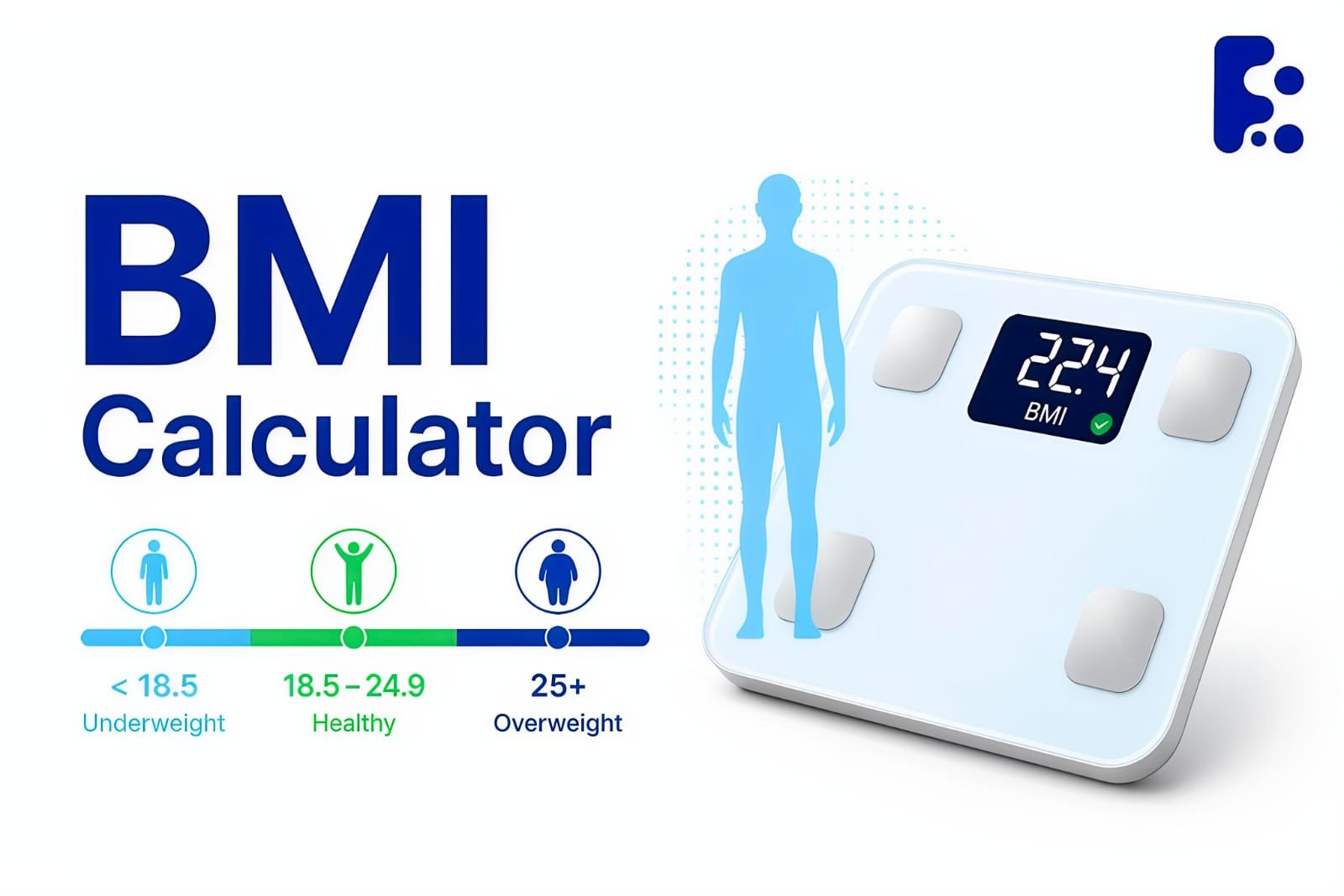
You know your height. You've just stepped off the scale. Now you're wondering what those two numbers add up to. That's the whole point of a BMI calculator online: type in both, and a second later you've got a single figure and the category it lands in.
It's fast, and most sites don't charge for it. It's also very easy to read too much into. So before you trust the number, it helps to know how it's worked out, what the categories actually say, and what BMI can't see.
What a BMI Calculator Online Does
BMI is short for body mass index. All it does is compare your weight to your height. A BMI calculator online runs the standard formula for you, then checks where the result sits against the usual ranges, so you don't have to do the sums or hunt for a chart.
The CDC calls BMI a quick, low-cost screening measure for underweight, overweight and obesity. Notice the word “screening”. BMI can show you where a conversation about health might begin. It can't diagnose anything by itself.
BMI Calculator Calculation: The Formula Behind the Number
The maths is short. In metric, you divide your weight in kilograms by your height in metres, squared. In pounds and inches, the usual version multiplies your weight in pounds by 703, then divides by your height in inches, squared.
Try it with someone who weighs 70 kg and stands 1.75 m tall. Multiply 1.75 by 1.75 and you get 3.0625. Divide 70 by that and you land on about 22.9, which sits in the healthy range for adults.
One thing trips people up more than the formula does. They type their height in centimetres where the tool wants metres. Most calculators convert for you, but if your result looks wildly off, check the units before you panic.
How to Calculate Body Mass Index Online
To calculate body mass index online, pick your units, enter your height and weight, and read what comes back. That's it.
A couple of habits help. Only use an adult calculator if you're 20 or older, since children are assessed differently (there's a section on that below). And if you're tracking BMI over time, step on the scale under similar conditions each time. The CDC says tracking over time can show weight gain or loss, which tells you more than one reading ever will.
Honestly, when you calculate BMI index online, the arithmetic is the easy bit. Knowing what to do with the answer is harder.
Adult BMI Categories
For adults aged 20 and older, the CDC uses these ranges:
- Less than 18.15 - Underweight
- 18.5 to less than 25 - Healthy weight
- 25 to less than 30 - Overweight
- 30 or greater - Obesity
Obesity is broken into three classes: Class 1 is 30 to under 35, Class 2 is 35 to under 40, and Class 3 is 40 or above. For adults, the CDC uses the same categories whatever your age, sex or race.
Here's what that looks like in real life. The CDC's example is an adult who's 5 feet 9 inches tall: a weight of 125 to 168 pounds falls in the healthy range.
What a BMI Calculator Online Can't Tell You
BMI only knows two things about you: how tall you are and how much you weigh. That's a lot to leave out.
The CDC is upfront that BMI can't tell fat from muscle or bone, even though all three add to your weight. It also doesn't show what kind of fat you carry or where it sits on your body. So two people with the same BMI can be quite different.
That's why the CDC suggests reading BMI next to other things: your medical history, your habits around food, activity and sleep, results from a physical exam such as blood pressure, and lab numbers like glucose and cholesterol.
Any online calculator for BMI can hand you a tidy number. It just can't hand you the whole picture.
A Note for Asian Adults
The categories above are the international standard, but they don't fit everyone equally well. A WHO expert consultation published in 2004 found that many Asian people already face a high risk of type 2 diabetes and cardiovascular disease at BMIs below 25.
The group kept the WHO cut-offs as the international classification. It also pointed to extra public health action points at 23.0, 27.5, 32.5 and 37.5, and left it to each country to decide how to define increased risk for its own population. If you're of Asian background and your result lands in the low to mid 20s, it's worth asking your doctor how to read it.
Children and Teens Need a Different Tool
Adult categories don't apply to anyone under 20. For ages 2 to 19, the CDC works out a BMI percentile, comparing the child with others of the same age and sex. Obesity in this age group means a BMI at or above the 95th percentile. So if you're checking for a child or teenager, use a child and teen calculator, not an adult one.
What to Do With Your Result
Think of the number as a starting point. If it's outside the healthy range, or you're not sure what it means for you, talk to a healthcare provider, who can look at it alongside everything else.
And try not to overhaul your diet or exercise because of one reading on a website. One figure can't know your health history.
Privacy: Think Before You Enter Your Details
Height and weight are personal. Some calculators say the calculation runs in your browser and nothing is sent to a server. Others don't say anything at all. Skim the privacy information first, especially if the tool asks for more than height, weight and age.
Wrapping Up
A BMI calculator online does one small job well. It turns your height and weight into a number and a category in a few seconds. What you do next matters more. Read the result as a screening signal, keep in mind what BMI can't see, and take any questions to a healthcare provider. This page is general information, not medical advice.