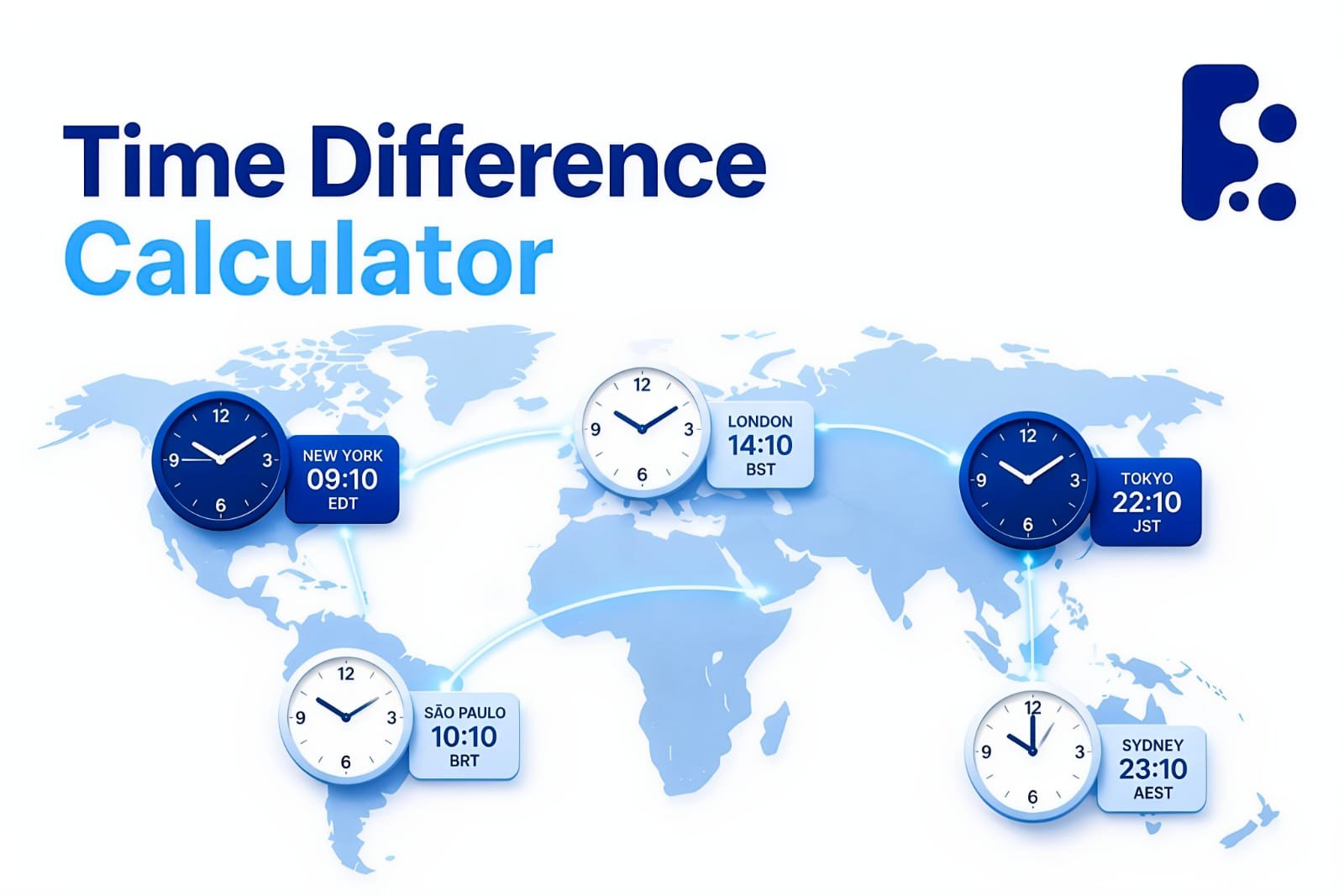
It’s 9 a.m. in New York. What time is it in India? If you had to pause and work it out, you’re in good company. Time zones look easy right up until half-hour offsets, clocks that change twice a year and a midnight you didn’t see coming get involved.
What Is a Time Zone Converter?
A time zone converter is the instrument which allows changing one specific time into another corresponding time. In other words, you will not have to do the calculations yourself, think about the daylight saving time and memorize all the countries ahead or behind. All you need is to input the time and the location.
In fact, every time zone converter operates on the basis of Coordinated Universal Time (UTC) - a standard global time used as the benchmark. The point is that every country is either ahead or behind UTC in a certain amount of hours and even minutes. For instance:
•New York (Eastern Time) is UTC-5 (or UTC-4 in daylight saving time)
•London (Greenwich Mean Time) is UTC+0 (or UTC+1 in British Summer Time)
•Tokyo (Japan Standard Time) is UTC+9 without daylight saving time
•Sydney (Australian Eastern Time) is UTC+10 (or UTC+11 in daylight saving time)
The only thing you need to use this instrument is to know the offset of your time zone.
What a Time Zone Calculator and a Time Difference Calculator Actually Do
People use the two names as if they mean the same thing. They don’t, quite.
A time zone calculator takes a time in one place and tells you what the clock says somewhere else. A time difference calculator answers a neighbouring question: how many hours apart are these two places? A few tools stretch the name further and measure the gap between two moments in days, hours and minutes.
The better tools do all three, and the good ones look at the date you enter before deciding whether daylight saving applies.
Time Zone Calculation by Hand: The Simple Method
Every time zone calculation comes down to offsets from UTC. India sits at UTC+5:30. The US East Coast sits at UTC-5 in winter. Subtract one from the other and you’ve got the time difference.
Take India and the East Coast in winter: 5:30 minus negative 5:00 is 10 hours 30 minutes. India’s ahead, so add that to the Eastern time and you’ve got the Indian time.
Two habits save you grief here. Write the date next to the time, because a 9 a.m. call in one place can be last night somewhere else, and the clock rolls over midnight when you cross it. And check your answer against a city name, not just a number. Some regions run on half-hour or even 45-minute offsets. India’s own half hour is the classic example of how a quick whole-hour guess goes wrong.
Why You Need a Time Zone Converter With Date
A converter that only asks for a time is quietly guessing the date. A time zone converter with date takes the guess out, for two reasons.
The first is the day itself. Cross midnight and the date changes, so you need to know whether your colleague’s meeting is today, tomorrow or already yesterday.
The second is daylight saving. The gap between two places can change depending on the calendar date. In the US, daylight saving begins on the second Sunday in March and ends on the first Sunday in November, with clocks changing at 2 a.m. local time. In 2026 those dates were March 8 and November 1. A tool that reads your date applies the rule for that day, not for today.
Time Difference Between EST and IST
This is the pair people search for most, and the one most often quoted wrong. The gap isn’t fixed. India doesn’t change its clocks, but the US does, so the difference moves with the US calendar.
|
US Eastern period |
Eastern offset |
India (IST) offset |
Time difference |
9:00 a.m. Eastern is |
|
Standard time (EST) |
UTC-5 |
UTC+5:30 |
10 hours 30 minutes |
7:30 p.m. in India |
|
Daylight time (EDT) |
UTC-4 |
UTC+5:30 |
9 hours 30 minutes |
6:30 p.m. in India |
Right now, until November 1, 2026, the US East Coast is on daylight time, which makes the gap 9 hours 30 minutes. Once the clocks go back, it’s 10 hours 30 minutes.
That shift is a classic way to wreck a recurring meeting. A call at 7:30 a.m. Eastern daylight time is 5:00 p.m. in India. After the US falls back, the same 7:30 a.m. call lands at 6:00 p.m. in India. If you run a standing India-US call, send a reminder after each change with the time written in both zones.
And one more trap: IST doesn’t always mean India. It’s also used for Irish Standard Time (UTC+1) and Israel Standard Time (UTC+2). If someone writes just “IST”, ask which one, or use a city.
What to Look For in a Time Zone Calculator
The tools that rank well for this search tend to share a short list of features, and they’re worth holding any tool up against. It should handle daylight saving by date, so it adjusts when one place is on summer time and the other isn’t. It should have a date field, so you see the result’s day as well as its time. It should let you pick cities rather than abbreviations, which sidesteps the EST/EDT and IST confusion. And ideally it lets you compare several places side by side, which helps once a meeting spans more than two zones.
If a tool hides any of those, treat its answer as a rough guide and double-check it.
Mistakes That Cause Missed Meetings
Most scheduling slips come from a few habits. People call Eastern time “EST” all year, when the East Coast is on EDT in summer. They round India’s half hour up or down to a whole hour. They send the invite without a date. They assume the gap between two places never changes. And they forget that some US places, Hawaii and most of Arizona among them, don’t observe daylight saving at all. Writing the time in both zones, with the date, covers nearly all of it.
Wrapping Up
Scheduling across borders is mostly bookkeeping, and a good time zone calculator - time difference calculator does the bookkeeping for you. Give it a date, pick cities instead of abbreviations, and keep in mind that the gap between places like the US East Coast and India moves when the US changes its clocks. Do those three things and the numbers look after themselves.